Quick answer
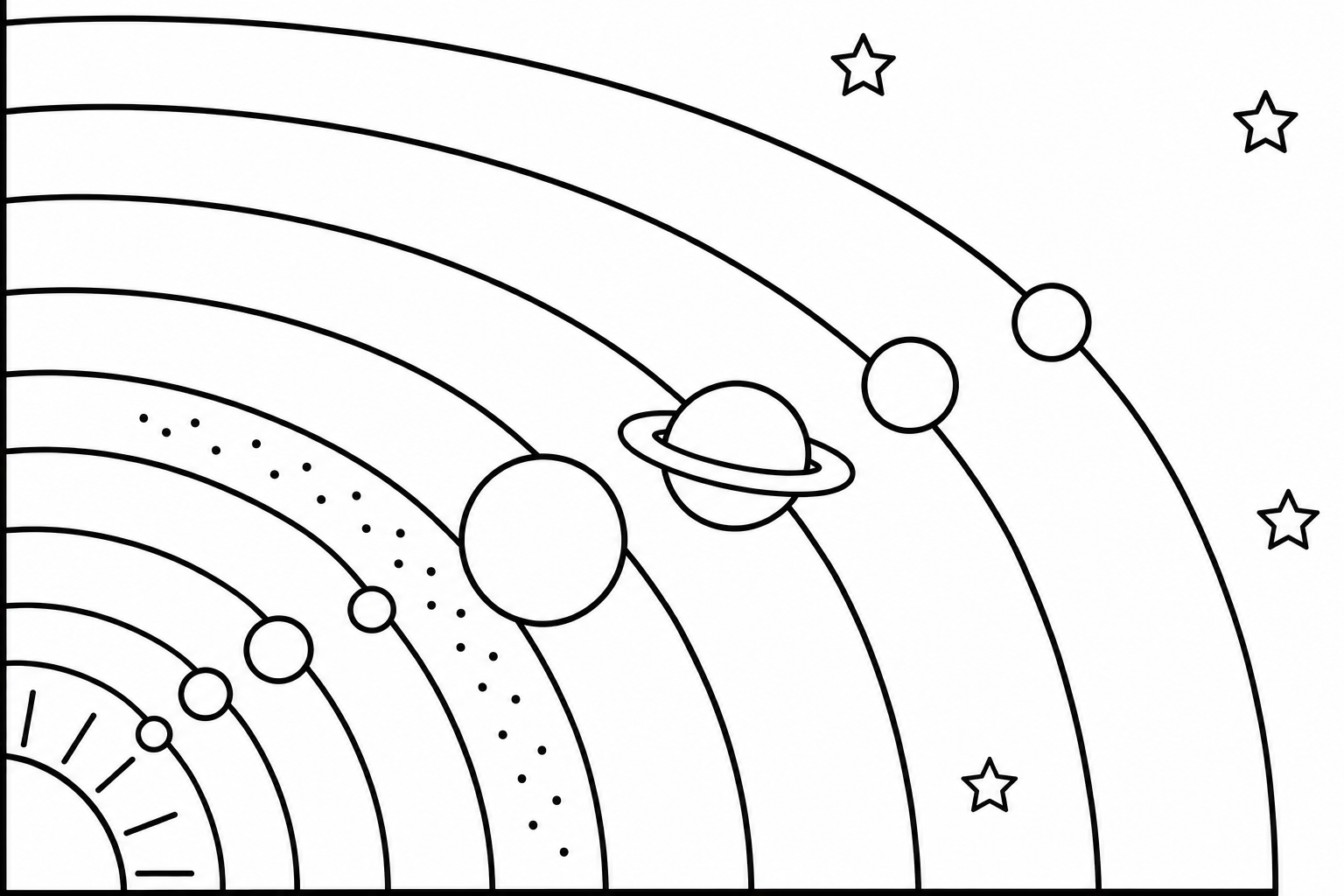
Put the sun in a corner of the page (a big quarter circle) and draw 8 arcs around it with slightly growing gaps — these are the orbits. Then place a planet on each arc in order from the closest to the sun: Mercury (small), Venus, Earth, Mars (small), Jupiter (the biggest), Saturn (big, with rings), Uranus, Neptune. The corner gives you more room than a full circle, and that is the secret of a tidy drawing.
⬇️ Download the full-size example drawing for printing (PNG)
What your child should know before drawing
The solar system is the sun and everything that orbits it: eight planets, their moons, and a belt of rocks (the asteroids) between Mars and Jupiter. The four planets near the sun are rocky and small; the four far ones are gas giants. Earth is the third planet and the only one we know with life. A sentence to remember the order: "My Very Easy Method Just Speeds Up Naming" (Mercury, Venus, Earth, Mars, Jupiter, Saturn, Uranus, Neptune).
Materials
A4 paper in landscape (or black paper with light pencils), a pencil, an eraser, a compass or coins of different sizes for the circles, colored pencils (yellow, orange, blue, red, brown, beige, light blue, dark blue).
Drawing steps
1. The sun: in the bottom-left corner draw a big quarter circle (about 5 cm radius) with short rays along its edge. 2. The orbits: draw 8 arcs around the sun with a light line, about 1.5 cm apart, slightly wider for the outer arcs. 3. The rocky planets: on the first arc a very small circle (Mercury), on the second a slightly bigger one (Venus), on the third one of about the same size (Earth) with a tiny circle beside it for the moon, on the fourth a circle smaller than Earth (Mars). 4. The asteroid belt: between the fourth and fifth arcs draw scattered small dots along the arc. 5. The giants: on the fifth arc the biggest circle in the drawing (Jupiter) with a small oval spot on it, and on the sixth a big circle (Saturn) with a tilted oval around it for the rings — erase the part of the ring that hides behind the planet at the top, and keep the part passing in front at the bottom. 6. The ice planets: on the seventh and eighth arcs two medium circles (Uranus and Neptune); Uranus can get a thin vertical line for its rings if your child likes. 7. Names and stars: write each planet's name under it in small letters and scatter small stars (dots and + marks) in the empty spaces.
Coloring
Sun yellow and orange, Mercury gray, Venus beige/pale yellow, Earth blue with green patches, Mars red/orange, Jupiter orange and brown with horizontal stripes, Saturn pale yellow with beige rings, Uranus very light blue, Neptune dark blue. Orbits stay thin gray lines.
Common mistakes
- All planets the same size: size is part of the information; Jupiter is the biggest and Mars and Mercury are the smallest.
- Wrong order: Venus comes before Earth and Mars after it; check the memory sentence.
- Rings on a planet other than Saturn: Uranus has thin rings too, but Saturn's rings are enough for a school drawing.
FAQ
Should I draw Pluto?
No; Pluto has been classified as a dwarf planet since 2006 and is not drawn among the eight planets, but it can be added as a small dot beyond Neptune labeled "dwarf planet".
Why is the sun in the corner and not in the middle?
Because the page cannot fit eight full circles with clear gaps; a quarter circle gives eight wide arcs and shows the order clearly.
How big is Earth compared to the sun?
The sun is more than a hundred times wider than Earth, so true sizes cannot be drawn on one page — a school drawing keeps only the order and the relative sizes between the planets.
From school drawings to a little artist
A school drawing is often the first place a child discovers that a pencil can explain what words cannot. If your child enjoyed this exercise, the kids drawing and coloring course has 84 recorded lessons in Arabic that start from holding the pencil and basic shapes and reach complete paintings in pastels and colored pencils, with a free first lesson and a 7-day money-back guarantee.