Quick answer
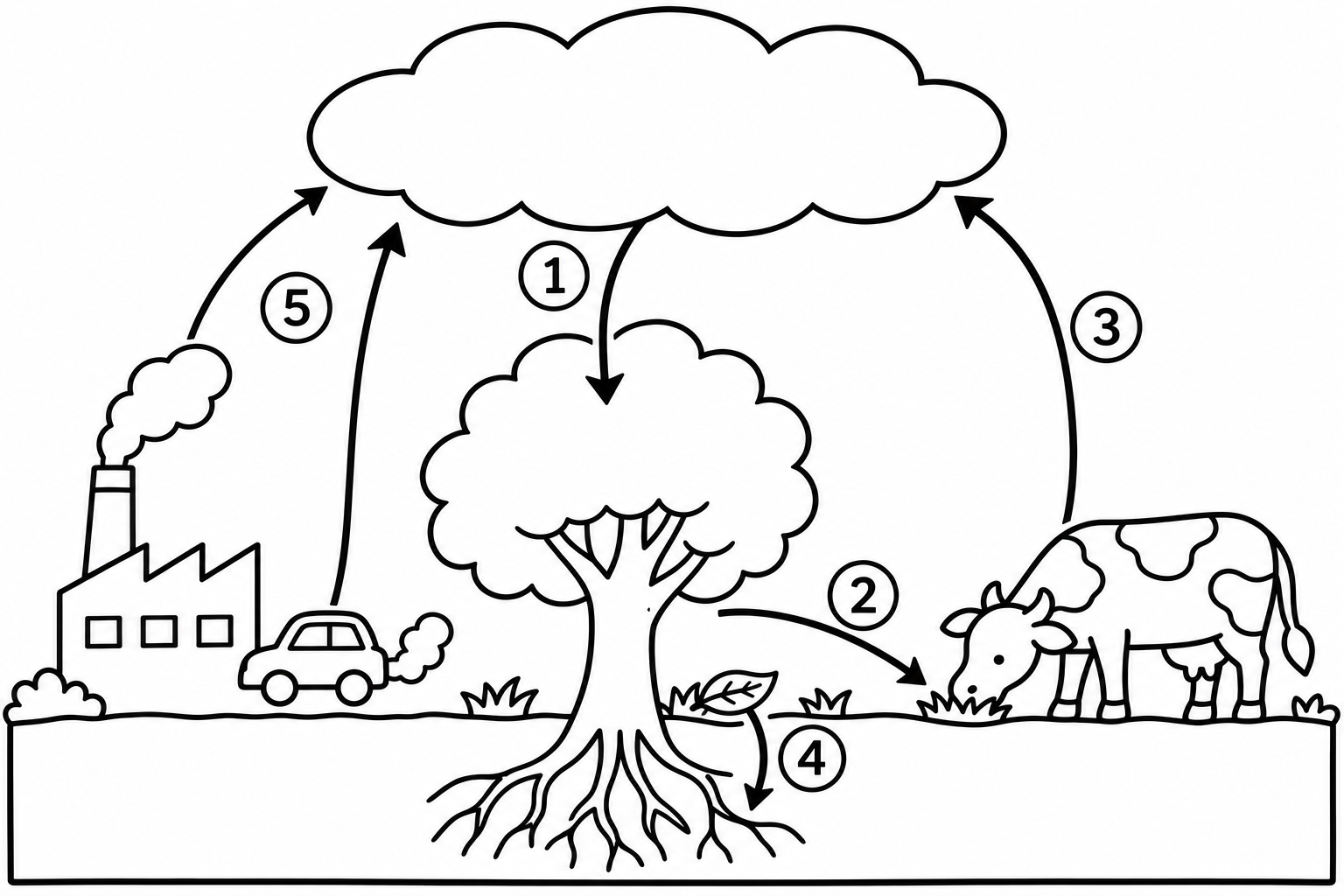
Draw a big tree in the middle and a cloud at the top standing for the air (where carbon lives as carbon-dioxide gas), a cow eating grass on the right, soil with roots and a fallen leaf at the bottom, and a factory or a car on the left. Then draw numbered arrows: 1 from the cloud to the tree (the tree takes carbon), 2 from the tree to the cow (eating), 3 from the cow to the cloud (breathing), 4 from the fallen leaf into the soil (decay), 5 from the factory to the cloud (burning).
⬇️ Download the full-size example drawing for printing (PNG)
The carbon cycle in kids' language
Carbon is a material found in everything alive: in leaves, in your body, in food, and in the air as a gas called carbon dioxide. Plants "catch" this gas from the air with their leaves to make their food with the sun's help (photosynthesis). When animals eat plants the carbon moves into them, and when they breathe they return part of it to the air (respiration). Dead leaves and animals decay in the soil, so carbon goes back into the ground (decomposition); some of it turns after millions of years into coal and oil, and when we burn fuel in cars and factories the carbon goes back into the air in large amounts (combustion). The cycle is balanced when plants take as much as is released — that is why we plant trees.
Materials
A4 paper in landscape, a pencil, an eraser, a thin black pen, colored pencils (green, brown, light blue, gray, yellow, red).
Drawing steps
1. Ground and sky: a horizontal line in the lower third with a strip of soil under it. A small sun in a corner. 2. The tree: in the middle draw a trunk (a brown rectangle), a big crown of connected curves like a cloud, and branching roots inside the soil. 3. The air cloud: at the top draw a big cloud and write clearly inside it "air" or "CO₂", as in the school book. 4. The cow and grass: on the right draw a simple cow (a rounded rectangle body, a head, 4 legs, spots) and short grass under its mouth. 5. The soil: in the bottom strip draw a fallen leaf and a few small dots (the decomposers), and a thin black layer at the very bottom labeled "coal". 6. The factory or car: on the left draw a factory (a rectangle with a saw-tooth roof and a chimney) or a simple car, with smoke going up. 7. Numbered arrows: draw the five arrows as in the quick answer, each with a small circle holding its number, and write a key at the bottom: 1 photosynthesis, 2 eating, 3 breathing, 4 decay, 5 burning.
Coloring
Tree and grass in green, trunk and soil in brown, the cloud in very light blue, the factory in gray with dark-gray smoke, and a yellow sun. Use red only for the burning arrow so it stands out.
Common mistakes
- Arrows without numbers: a carbon-cycle drawing is understood through its arrows, not its pictures; numbers and a key are a must.
- Forgetting the soil: decay is the stage teachers most often ask about.
- Too much detail: one tree, one animal and one factory are enough.
FAQ
Which grades is this drawing for?
Usually grades 4 to 6; for younger children three arrows are enough (photosynthesis, eating, breathing).
What is the difference between the carbon cycle and the water cycle?
The water cycle follows water between sea, sky and land; the carbon cycle follows carbon between the air, living things, soil and fuel. Both are circles that never end.
Should I draw the sea?
If the book asks for it, draw a small sea at the side of the page with a two-way arrow between it and the cloud, because the sea both absorbs and releases carbon.
From school drawings to a little artist
A school drawing is often the first place a child discovers that a pencil can explain what words cannot. If your child enjoyed this exercise, the kids drawing and coloring course has 84 recorded lessons in Arabic that start from holding the pencil and basic shapes and reach complete paintings in pastels and colored pencils, with a free first lesson and a 7-day money-back guarantee.