Quick answer
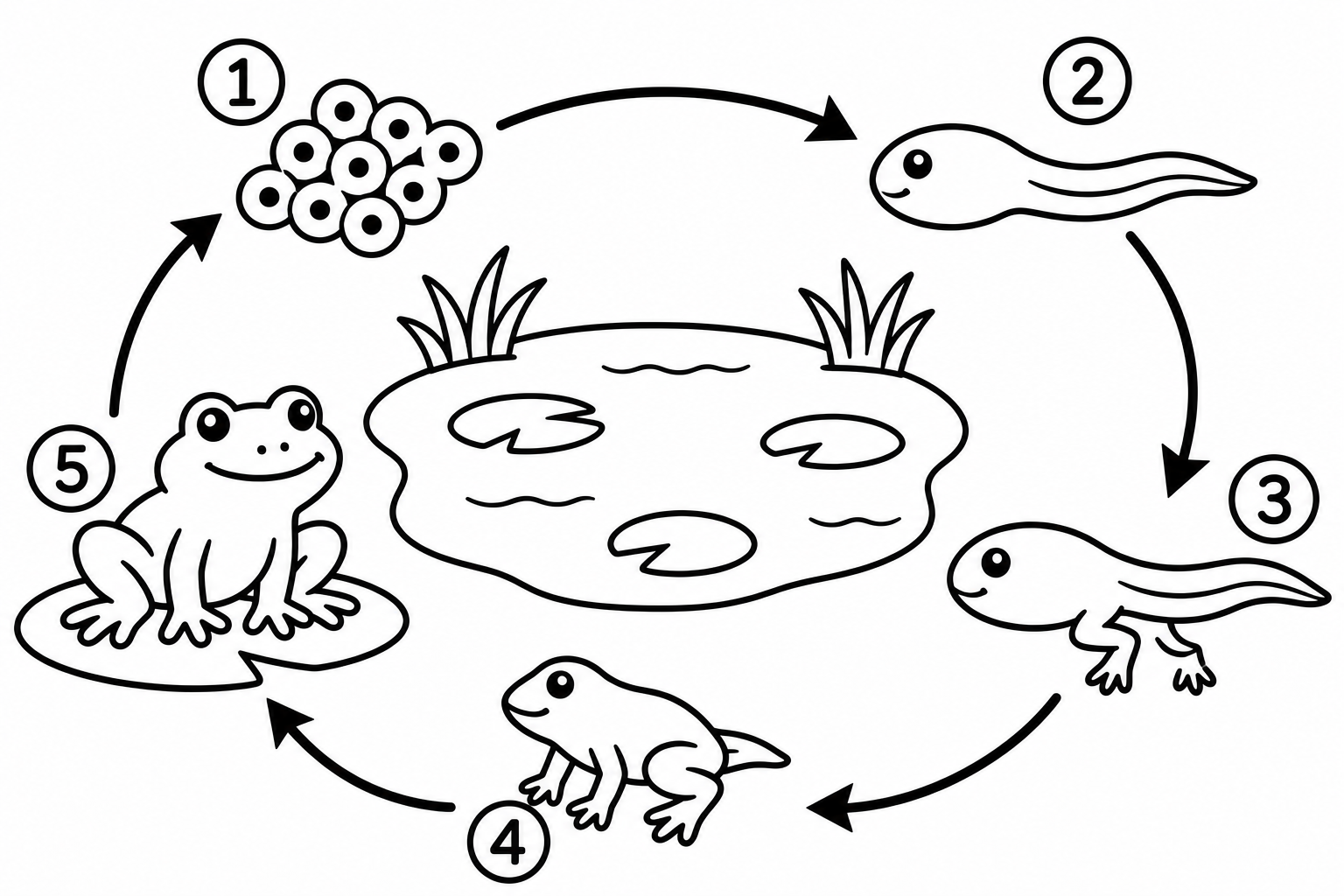
Draw an oval pond in the middle of the page and place 5 stages around it clockwise: a cluster of eggs made of small circles, a tadpole (round head and tail), a tadpole with back legs, a froglet with a short tail and front legs, then the adult frog on a lily pad. Connect them with arrows numbered 1 to 5.
⬇️ Download the full-size example drawing for printing (PNG)
The frog life cycle in simple words
A female frog lays hundreds of eggs in the water as a jelly-like cluster; tadpoles hatch, swim with their tails and breathe with gills like fish; then back legs grow, then front legs, the tail gets shorter until it disappears, lungs develop and the froglet climbs onto land, grows into an adult frog and returns to the water to lay eggs. A frog lives both in water and on land, which is why it is called an amphibian.
Materials
A4 paper in landscape, a pencil, an eraser, a thin black pen, colored pencils (light and dark green, blue, black, brown).
Drawing steps
1. The pond: draw a big oval in the middle of the page, short wavy lines inside for water, and three lily pads (circles with a missing wedge, like a pizza slice). 2. Stage 1 — eggs: at the top left draw a cluster of 8 to 10 small touching circles with a black dot inside each. 3. Stage 2 — tadpole: at the top draw a circle for the head and a long curved tail that narrows at the end, plus a small eye. 4. Stage 3 — tadpole with legs: on the right draw the same shape with two small back legs like a flipped Z on either side of the tail. 5. Stage 4 — froglet: at the bottom draw an oval body, four legs, a very short tail and bulging eyes. 6. Stage 5 — adult frog: on the left draw a frog sitting on a lily pad: oval body, wide head with big eyes on top, a wide smiling mouth, two big folded back legs and two small front legs. No tail. 7. Arrows and numbers: draw curved arrows between the stages clockwise and write 1 to 5 inside small circles.
Coloring
Water in light blue, eggs in very light gray with black dots, tadpoles in black or dark brown, frogs in light green with dark-green spots on the back, and lily pads in dark green.
Common mistakes
- A tail on the adult frog: the tail disappears completely in the last stage.
- Eyes on the side of the head: a frog's eyes sit on top of the head and bulge; that is what makes its shape recognizable.
- Too many or too few stages: school books usually use 4 or 5 stages; follow your child's book.
FAQ
What is the difference between a frog and a toad?
A frog's skin is smooth and moist and its legs are long for jumping; a toad's skin is bumpy and it walks more than it jumps. For a school drawing, the frog is enough.
Should I draw the lungs?
No; it is enough to write "starts breathing with lungs" under stage 4 if the child is in grade 3 or above.
How long does the whole cycle take?
In most frogs, from egg to small frog takes about 2 to 3 months, depending on the species and the water temperature.
From school drawings to a little artist
A school drawing is often the first place a child discovers that a pencil can explain what words cannot. If your child enjoyed this exercise, the kids drawing and coloring course has 84 recorded lessons in Arabic that start from holding the pencil and basic shapes and reach complete paintings in pastels and colored pencils, with a free first lesson and a 7-day money-back guarantee.