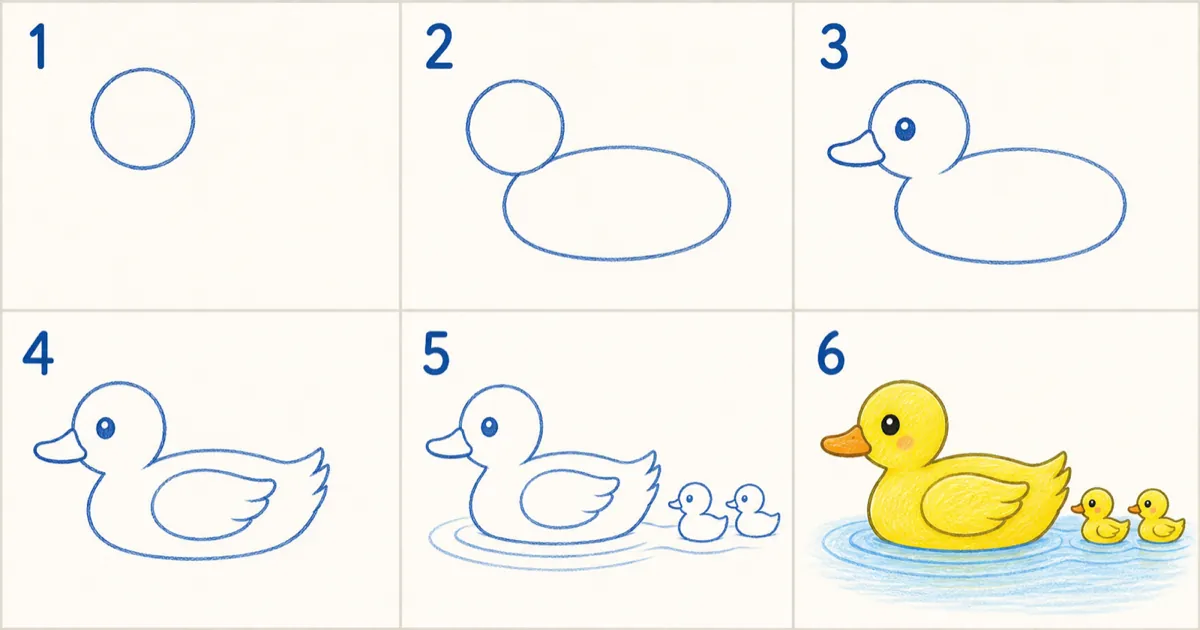
The yellow duck is every child's old friend — from the rubber bath toy to nursery songs — and today we move her from the bathtub to the drawing paper. The duck lesson differs from everything in our series so far with something completely new: water! The duck is the first animal we draw swimming, meaning her lower half disappears under the waterline — a clever artistic idea your child learns today that also saves them from drawing any legs. We'll draw our duck first, then build her lake, then add the sweetest detail in the duck world: a line of ducklings paddling behind their mother in a perfect queue.
We need a horizontal sheet — lakes are always wide — a pencil and eraser, and yellow, orange, and blue for coloring.
Quick Answer
To draw an easy duck, begin with one circle for the head and a horizontal oval for the body. Add a flat rounded beak, an eye, a wing and a small tail, then draw water ripples and two little ducklings behind the mother.
What Are the Easy Duck Drawing Steps?
- 1) Draw a medium circle in the upper half of the page's middle — the duck's head.
- 2) Below it and slightly to the side, draw a big horizontal oval touching it — the floating body. No long neck today; a duck's head sits close to her body.
- 3) The bill — the star of the lesson: at the head's front edge, draw a wide flat shape like a small upside-down spoon, with a horizontal line through its middle separating the two halves. A duck's bill is wide and flat — never a sharp triangle!
- 4) The eye: a small circle just above the bill, with a black dot and a white sparkle inside.
- 5) The wing: a big arc inside the body starting from its middle and sweeping back — like a ribbed leaf with two inner feather lines.
- 6) The tail: two short lines flicked upward at the body's rear — the duck's cheeky tail, always raised as if saying hello.
- 7) Now the golden idea: draw a wavy horizontal line across the body's lower part — the waterline! Everything below it is "submerged": no legs, no belly — the water hides them. The easiest legs lesson in the world: no legs!
- 8) Add small water arcs around the duck — the swimming ripples she leaves behind.
The Most Famous Mistake Here: The Sparrow Beak
We see it in nearly every group of kids: the child draws a sharp triangle beak — like the bird from our previous lesson — and the duck instantly becomes a strange chicken! The reason is understandable: a triangle is the easiest shape and the first the hand remembers. The fix is one comparison sentence a child keeps forever: "a duck's bill is a spoon; a bird's beak is a knife." The spoon is wide and flat for scooping water; the knife is pointed for picking seeds. Ask them to draw a small upside-down spoon in place of the bill and they'll nail it on the first try — learning along the way that a playful analogy beats a thousand corrections.
Building the Lake: The Duck's Big Home
- The shoreline: a wide arc enclosing the lower area of the page — everything inside is water, everything outside is land.
- The ripples: small scattered arcs across the water's surface — in twos and threes, never filling every gap; a little is enough for the feel of water.
- Reeds on the bank: vertical lines each topped with a small brown oval — the famous lake plant; three reeds at different heights are plenty.
- A water lily: a flattened green oval on the surface with a triangular notch on one side — and we've just prepared the frog's seat for a future lesson!
Coloring the Duck: Three Characters from One Drawing
Before grabbing the colors, tell your child that a duck's color decides who she is, then let them pick one of three:
- The classic yellow duck: sunny yellow all over with an orange bill — the nursery-song duck everyone knows.
- The white duck: a body left paper-white with light gray shading under the wing and a yellow bill — the elegant farm duck.
- The colorful wild mallard: here's the lovely surprise — a shiny green head, a thin white collar around the neck, a brown chest, and a gray body! Show your child a real mallard photo and they'll be amazed that nature colors more boldly than any of us.
Whatever the choice, color the water light blue with relaxed horizontal strokes — horizontal strokes alone suggest a calm, flat surface.
The Sweetest Touch: The Duckling Queue
Behind the mother duck, draw three tiny ducks using the same steps — a small circle, a smaller oval, a dot of a bill — each slightly smaller than the one before, all in a straight line behind mom. This famous queue does three things at once: it trains your child to redraw the same figure at different sizes (the skill of scaling), it fills the picture with story and warmth, and it creates the loveliest family drawing to gift to Mom on any occasion. And the final laugh: let the last duckling drift slightly out of line, staring at a butterfly — every family has its little rascal!
The Bottom Line
A circle, an oval, an upside-down spoon, and a wavy waterline — and the result is a duck genuinely swimming in a lake with a story and a family. Today your child learned the waterline hiding trick, the art of scaling with the duckling queue, and that a sweet analogy holds shapes in memory better than a thousand corrections. Bigger lakes and scenes await in the Rasm Kids course — video lessons that build a whole world, lesson by lesson.
From the duck to her small flying cousin: the easy bird drawing for kids lesson — one circle and a full leafy branch scene.
About Kids Art Academy
This lesson is part of the Kids Art Academy drawing library for children. The academy offers the Rasm Kids course with instructor Majada Al-Shouli, who holds a master’s degree in fine arts and specializes in teaching drawing to children and adults.
FAQs About Duck Drawing for Kids
How do you draw the duck beak correctly?
Use a flat rounded oval that comes out from the middle of the head instead of a sharp bird beak.
Which colors work best?
Use yellow for the body, orange for the beak and light blue for the water. Creative colors work too.
What age is this lesson for?
It suits beginners ages five and up because it relies on one circle, one oval and gentle curves.


