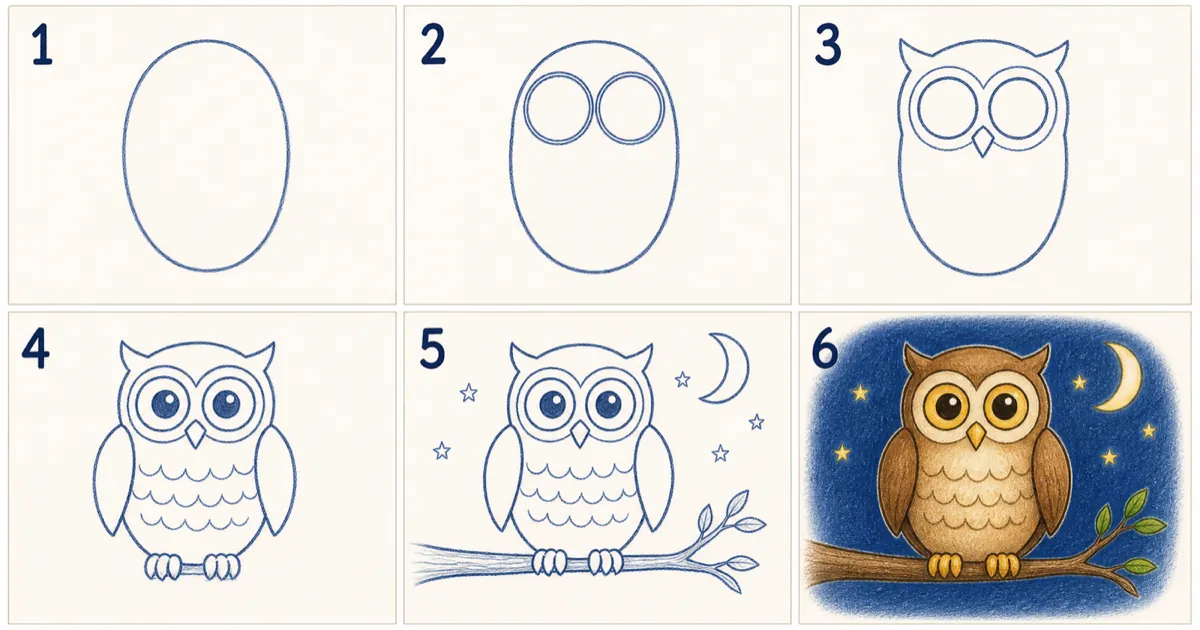
How does your child draw an easy owl? With one big oval holding the head and body together, then two huge eyes filling half the face — the owl's whole secret — plus a triangle beak, two feather "ears," rows of arc feathers on the chest, two wings, and claws: just seven steps. Then we paint the series' first complete night scene: a branch, a moon, stars, and a dark sky that makes the eyes glow. A calm, magical lesson made for evening sessions.
We need a vertical sheet, a pencil, brown and orange for the owl, dark blue or black for the night sky — and a piece of white chalk or a white pencil for the stars if you have one.
Quick Answer
To draw an easy owl, start with one tall oval body and two very large circular eyes. Add a tiny beak, wings, rows of curved feathers and small feet, then place the owl on a branch and color it with warm browns and gold.
What Are the Easy Owl Drawing Steps, in Order?
- 1) Draw a big plump oval in the middle of the page — head and body together; an owl is one connected ball of feathers with no visible neck.
- 2) The eyes — queens of the face: two very large circles nearly touching, in the upper half — together they should fill half the face's width! Inside each, a smaller orange circle, then a big black dot with a white sparkle.
- 3) The beak: a small upside-down triangle between and just below the eyes — short and pointed.
- 4) The feather ear tufts: two small feather triangles at the head's upper corners, with tiny hair strokes at their tips — the owl's famous marker (and they're feathers, not real ears — a fact that astonishes kids!).
- 5) The feather chest: fill the body's lower half with rows of small stacked arcs alternating like roof tiles — three or four rows are enough. They're the fish scales your child already mastered, upside down!
- 6) The wings: two long arcs down the body's sides from shoulder to near the bottom — like a closed coat the owl wraps around herself.
- 7) The talons: three short hooked lines under the body on each side, gripping the branch to come.
How Do We Paint the Night Around the Owl?
Here your child learns a skill entirely new to the series — building a whole atmosphere around a character:
- The branch: two thick horizontal lines under the owl's talons spanning the page, with a light wiggle and a small fork at the end.
- The moon: a big circle in an upper corner — a full moon with two faint gray patches, or a crescent from two arcs for those who like a challenge.
- The stars: scattered dots and small + marks across the sky — best of all, one or two five-pointed stars your child already knows.
- A thin night cloud passing across the moon's edge — a simple cinematic touch that creates surprising depth.
- The most important coloring: the entire sky in dark blue around the owl and moon — and your child discovers the magic of contrast: the darker the sky, the brighter those orange eyes glow!
Before coloring, the owl options map in one table:
| Owl | Body | Signature touch |
|---|---|---|
| Classic | Dark and light brown | Glowing orange eyes |
| Snowy | White with soft gray dots | The polar queen hiding in snow |
| Silver | Calm gray | The winter-nights owl |
| Star owl | Blue with tiny star patterns | A piece of the night sky itself |
Which Colors Suit the Owl Best?
Warm brown is the classic guard uniform — a dark shade for body and wings, lighter for face and chest, with glowing orange for eyes, beak, and talons. But the owl family is far wider, so offer your child enchanting alternatives: the snowy white owl with faint gray dots — the polar queen who vanishes into snow; the silver-gray owl of winter nights; or — for imagination lovers — the star owl: a blue body patterned with tiny stars, as if cut from the night sky itself. Whatever the choice, one rule remains: glowing orange or golden eyes — they are the whole painting's two lanterns.
The Rotating Head Fact — and Its Game
Tell your child the most famous owl fact: an owl can turn her head to look fully behind her without moving her body! Then turn the fact into a fun exercise: draw two owls side by side on the same branch with identical bodies — the first facing us as in our lesson, the second "head-turned": the same oval but the whole face drawn toward the right with the eyes at the edge. Two owls, two personalities — one guarding us, one who just heard a sound in the forest!
Why Does My Child's Owl Sometimes Look Off?
If your child's owl looks "off," there's only one cause: small eyes. A real owl's eyes are unbelievably huge — if ours matched the proportion, they'd be the size of two oranges! The golden rule for the child: "if you suspect the eyes are too big — they're probably still too small." Enlarge them boldly and watch the owl come alive instantly.
The Bottom Line
One oval, two moon eyes, arc feathers, and a dark sky — and the result is the first complete night painting in your child's sketchbook, with a guardian keeping watch at its center. Today they learned that a drawing can carry a time (a whole night!), not just a character, and that dark-light contrast creates light itself. Atmosphere and full-scene lessons continue in the Rasm Kids video course — from sunlit forests to deep space.
FAQs About Drawing an Easy Owl
Why do we draw the owl's eyes so big? Because real owl eyes are genuinely enormous — at our proportions they'd be the size of two oranges! The golden rule: if you suspect the eyes are too big, they're probably still too small.
Are the owl's "ears" in the drawing real ears? No — the two feathery triangles on the head corners are just feathers, not ears; the real hearing hides on the sides of the head. A fact that always amazes kids!
When is the best time for the owl lesson? Evening, before bed: the night painting finishes while real night looks in through the window — and the lesson's calm pace makes it a perfect wind-down.
How do we make the owl's eyes "glow" on paper? With the magic of contrast: the darker your child colors the sky around the owl, the brighter the orange eyes burn — their first "lighting" rule ever.
What should my child draw after the owl? Its small daytime cousin: the easy bird drawing for kids lesson — one circle and a full branch scene — completing the bird family with a night painting and a day painting.
About Kids Art Academy
This lesson is part of the Kids Art Academy drawing library for children. The academy offers the Rasm Kids course with instructor Majada Al-Shouli, who holds a master’s degree in fine arts and specializes in teaching drawing to children and adults.


