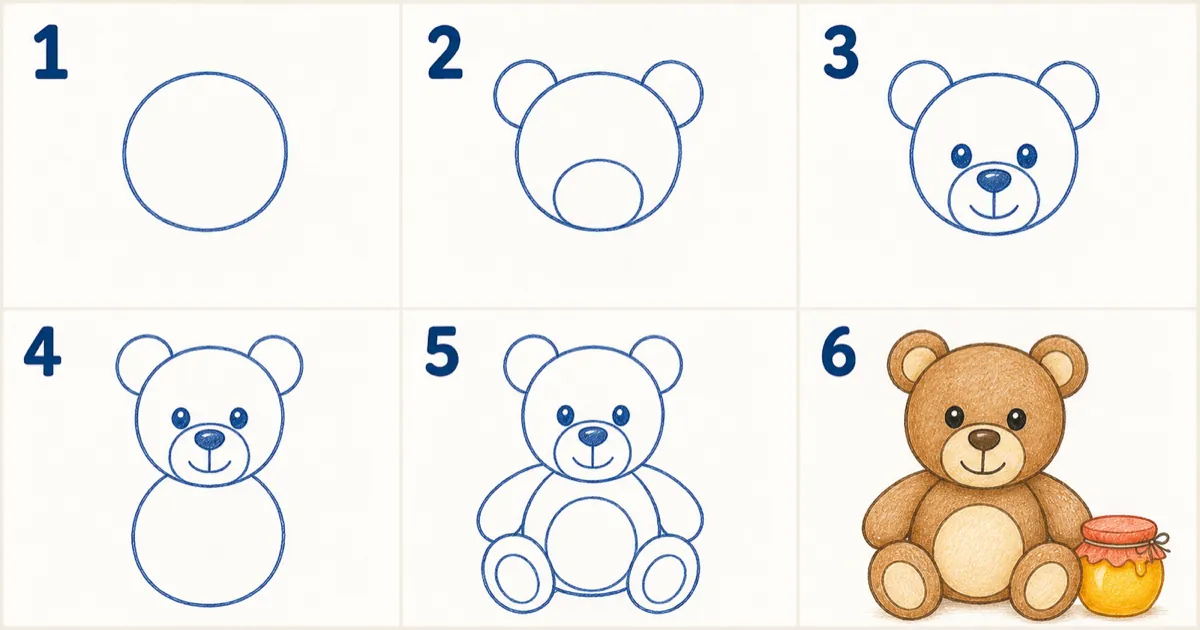
If there's a stuffed teddy in your child's room hugged every night, today's lesson will be the dearest of the whole series: we're drawing that exact cottony friend. The bear is a gift to young artists for a beautiful geometric reason: every part of it is a circle — the head a circle, the ears circles, the muzzle a circle, the body a big circle, even the feet circles — so a child needs only one skill they've had since their first scribbling days. We'll draw the teddy first, then I'll show you how three tiny touches turn it into a real forest bear, and we'll close with the most famous accessory in bear history: the honey pot.
We need a vertical sheet, a pencil, and brown in two shades — dark for the body, light for the muzzle and belly.
Quick Answer
The easiest way for a child to draw a bear is to build the teddy from simple circles: one for the head, two for the ears, one for the muzzle, a larger one for the body, then rounded arms and feet. Finish with warm brown coloring, a beige belly, and a small honey pot.
What Are the Easy Bear Drawing Steps?
- 1) Draw a big circle in the upper half — the head. Bears' heads are perfectly round, so don't fear a full circle.
- 2) At the head's upper sides, draw two medium circles — the round ears, each with a smaller lighter circle inside. A bear's ears sit on the head's "corners," not straight on top — that's the difference from a mouse!
- 3) In the lower middle of the face, draw a slightly wide circle — the light muzzle — with a dark horizontal oval inside: the big nose, the most important bear feature of all.
- 4) Two small round eyes above the muzzle — bear eyes are small, unlike most of our previous animals, and that's what gives the calm gentleness.
- 5) From under the nose, a short line branching into a quiet two-arc smile.
- 6) The body: a circle bigger than the head touching it from below — plump and wide like a cushion, with a big lighter oval inside: the round belly.
- 7) Limbs in circles too: two full arc arms at the body's sides with round paws, and two big circle feet at the bottom — with a small light oval inside each foot: the famous paw pad that marks teddy drawings the world over.
Darken the lines, erase the extras, color — and hug the result if you like; nobody will judge.
Three Touches That Turn Teddy into a Forest Bear
Here your child learns a refined artistic lesson: one character changes identity through small details. The exact same drawing with:
- 1) Claws: three short lines at the end of each paw and foot — alone enough to turn a "toy" into an "animal."
- 2) A straight mouth instead of the smile: a calm horizontal line makes the look serious and wild — try both and compare the two personalities.
- 3) A humped back: when drawing the forest bear's body, raise the top of the back into a slight hump instead of a perfect circle — the real bear's signature shoulder.
Then ask your child: which bear is yours? Most children choose the teddy — and that's excellent; what matters is they now know the decision is theirs and the details are their tools.
The Honey Pot: The Legendary Accessory
No bear is complete without its honey pot: next to the bear (or in its arms) draw a jar shape — a wide oval narrowing slightly at the top — with an oval-line lid, and a golden honey drop spilling over its rim. For the full scene: a little bee hovering above the pot as a striped circle with two dot wings — and we'll learn to draw the complete bee with all her details in an upcoming lesson of this very series, so consider this a teaser visit!
Bears of the World in Their Colors: Brown, White, and Panda
One drawing, and colors carry it around the planet — hand your child the bears' passport and let them pick a destination:
- The brown bear: the classic in two shades — dark for the body, light for muzzle, belly, and paw pads.
- The polar bear: the body left paper-white with light blue-gray shading at the edges and a shiny black nose — and add an iceberg of two triangles behind it!
- The beloved panda: a white body with black ears, arms, and feet, plus the most famous detail in the bear world: two black circles around the eyes. Don't forget the bamboo branch in its paws — a green line with long thin leaves.
Three bears from one drawing — hang them side by side, write "Bears of the World" underneath, and it becomes one of the sketchbook's finest pages.
Why the Bear Is Our Series' "Confidence" Lesson
Notice what happened today: no angles, no new shapes, no hard proportions — circles only, and your child has drawn circles for years. That's why we place the bear mid-series on purpose: after the challenges of the horse and the butterfly, the young artist needs a lesson they ace overwhelmingly on the first try, refilling the confidence tank. If your child draws the bear quickly and asks for more, suggest a "bear family": a big bear, a medium mama bear with a bow, and a small teddy — three sizes of the same circles, a perfect scaling exercise disguised as play.
The Bottom Line
Seven circles made a teddy, three touches made it a forest bear, and a honey pot gave it a story. Today your child recharged their confidence with the easy circles lesson and learned that tiny details — a claw, a mouth, a hump — change a drawing's whole identity. More beloved characters await in the Rasm Kids course, where video lessons teach step by step how to give every drawing its own personality.
About Kids Art Academy
This lesson is part of the Kids Art Academy drawing library for children. The academy offers the Rasm Kids course with instructor Majada Al-Shouli, who holds a master’s degree in fine arts and specializes in teaching drawing to children and adults.
FAQs About Easy Bear Drawing for Kids
What age is this bear drawing for?
It works well for beginners ages five and up. Younger children can trace a cup or circle template for the main shapes.
What is the easiest way to draw the bear?
Start with the largest circles, then add the ears, muzzle, belly, arms and feet using very light pencil lines.
Which colors work best?
Brown and beige make a classic teddy. White creates a polar bear, while black and white turn the same shapes into a panda.


