Ten... nine... eight... grab the pencils before the countdown ends! Today's lesson is the most thrilling of the whole vehicle batch: the space rocket — the only vehicle that leaves our entire world. Its artistic charm is combining, in one drawing, the easiest shapes (a pointed oval and three triangles) with the most magical backdrop in drawing history: space, with its planets, stars, and the velvet darkness we learned to handle in the owl's night lesson. We'll build the rocket piece by piece, ignite the engines, then swim through wide space — and the countdown is an official part of the ritual!
We need a vertical sheet — rockets go up! — a pencil, red, orange, and yellow for the flames, and dark blue or black for the space sky.
Quick Answer
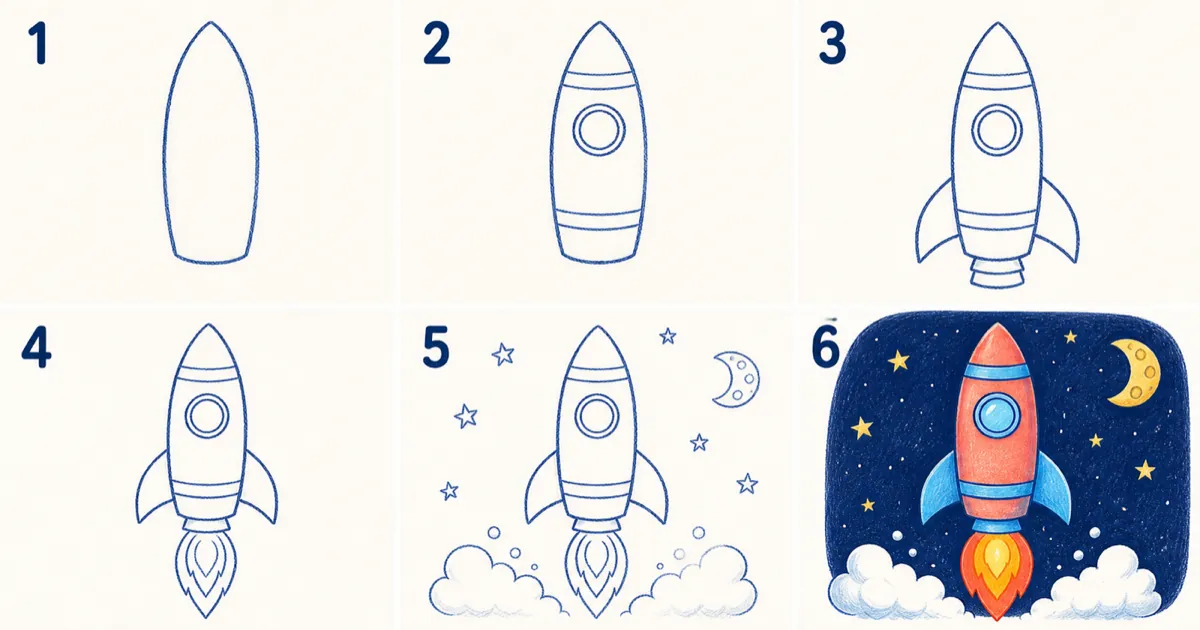
To draw an easy rocket, begin with a tall body pointed at the top. Add a round window, body bands and two side fins, then draw a nozzle and a three-layer flame. Finish the scene with stars, a moon and smoke clouds.
What Are the Easy Rocket Drawing Steps?
- 1) In the middle of the page, draw a tall vertical oval pointed at the top — the rocket's body, like a giant upside-down water drop or a friendly bullet aimed at the stars.
- 2) The colored nose: draw an arc separating the pointed tip from the rest and color that part red — the famous red cap of every cartoon rocket.
- 3) The porthole: a big circle at the body's middle holding a smaller circle — the ship's thick window, with the little astronaut's face peeking through: a circle head inside a bigger circle helmet!
- 4) The fins: two big triangles at the base's sides widening downward — the rocket's steady feet, plus for those who want a third: a small triangle peeking from behind the middle.
- 5) The nozzle: a small trapezoid closing the body's base — where the fiery roar exits.
- 6) The body lines: two thin horizontal lines dividing the rocket into floors, with tiny dot bolts along their edges — details for little engineers.
Igniting the Engines: The Layered Flame
The liftoff flame is the drawing's soul, and drawing it right is a mini color lesson: under the nozzle draw three nested flame layers — a big jagged outer flame in red, a smaller one inside in orange, and at the heart a small flame in bright yellow. The beautiful science rule to share while coloring: fire's heart is hottest, so it's lightest in color! Complete the scene with two puffy smoke clouds at the flame's sides near the ground — the sheep lesson's cloud scribble on a launch mission — and small vibration strokes around the rocket's base: the engines are roaring!
Wide Space: The Backdrop of Dreams
- The planets: a big orange circle with horizontal stripes (striped Jupiter), a smaller red circle (neighbor Mars), and the eternal favorite: a ringed planet — a yellow circle crossed by a flattened oval like a hat — Saturn, the star of all space drawings.
- The stars: a mix of dots, + marks, and small five-pointed stars — denser than the owl's night; we're now among the stars, not beneath them!
- Beloved Earth from afar: a small blue circle in a lower corner with green patches — our home shrinking as we rise, with a touching detail: a small arrow pointing at it labeled "our home."
- A passing comet: a small circle with a tail of long glowing lines cutting a corner — a swift visitor saluting our rocket.
- The big coloring: fill the whole sky dark blue around everything — and the owl lesson's magic moment repeats: every color ignites against the dark background.
The Launch Ritual: The Official Countdown
Turn the drawing's completion into an unforgettable celebration: put the drawing on the wall, dim the room lights, and count down in one voice: ten, nine, eight... and at "zero — liftoff!" your child slowly raises the drawing toward the ceiling, simulating the ascent. Sounds like a simple game? It's deeper: a child who celebrates their artistic achievement links drawing to a full-body memory of joy — and that memory is what brings them back to the pencils tomorrow and the day after. Then the post-launch question: where is the rocket headed? The Moon? Saturn? A new planet they invent and name? The next journey starts from the answer.
A Common Stumble: The Lazy Lying Rocket
The one repeated error here: a tilted or horizontal rocket that looks napping instead of launching. The decisive reminder: "a rocket is an arrow pointing at the stars — nose up, always, with no lean at all." And here's a teaching gem worth pausing on: this is the exact opposite of the airplane rule! The plane tilts to fly; the rocket straightens to launch — and when your child grasps that every vehicle has its own motion rule, they've made real progress in artistic thinking.
The Bottom Line
An upside-down drop, three triangles, a window with a little astronaut, and a three-layer flame pushing everyone toward endless stars — that's the rocket your child built and launched with an official countdown. Today they learned fire's color gradient, the straight-versus-tilted rule, and that celebrating a drawing is part of drawing itself. Tomorrow the journey lands on water... in a sailboat! And the Rasm Kids course video lessons await their little astronauts with worlds no rocket can reach.
About Kids Art Academy
This lesson is part of the Kids Art Academy drawing library for children. The academy offers the Rasm Kids course with instructor Majada Al-Shouli, who holds a master’s degree in fine arts and specializes in teaching drawing to children and adults.
FAQs About Rocket Drawing for Kids
Which shapes make the rocket?
Use one pointed oval for the body, a circle for the window, two curved triangles for the fins and three nested flame shapes.
How do you color the flame?
Draw a large red outer flame, a smaller orange flame inside it and a small yellow center.
What age is this lesson for?
The steps suit beginners ages five and up. Younger artists can draw the rocket without the space background.


